Guides · Buying a printer
Enclosed vs open 3D printers, bed slingers vs CoreXY, and build volume
What an enclosure really does, how bed-slinger and CoreXY printers differ, and how much build volume you need, explained with makers' specifications checked on 15 November 2026.
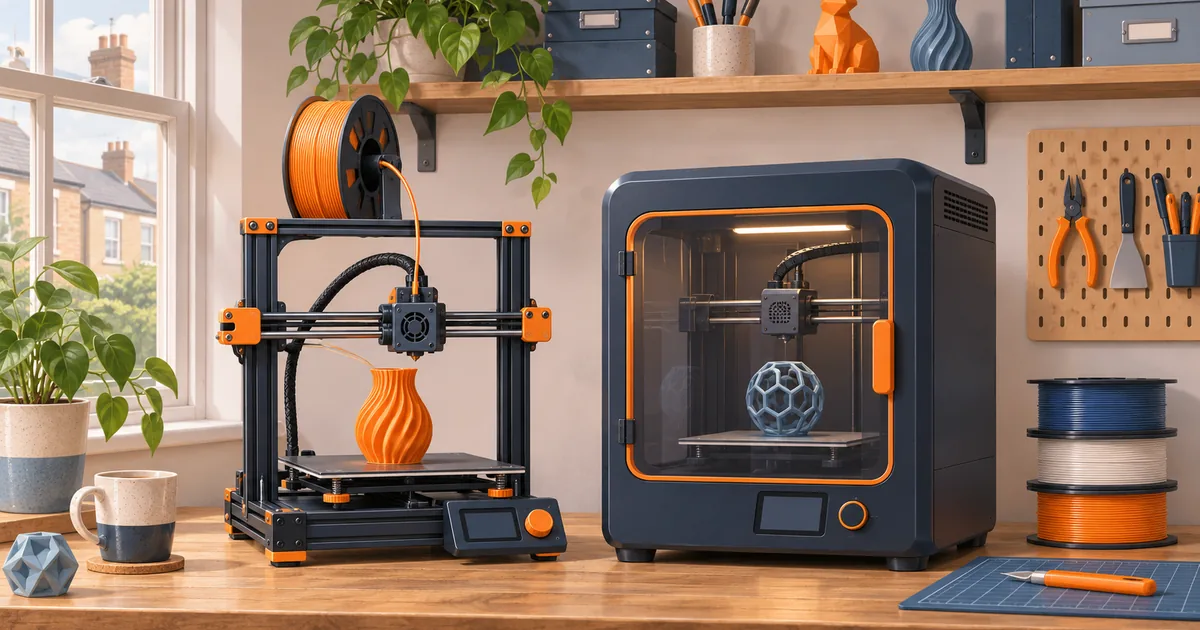
Three design choices shape almost every desktop printer: whether it has an enclosure, how its axes move, and how big its build volume is. They decide which materials you can print well, how much space the printer needs, and how easy it is to live with.
What an enclosure does
An enclosure is a box around the print area, usually plastic panels with a glass or acrylic door. It does three useful things:
- It keeps heat in. Materials such as ABS and ASA shrink as they cool and can warp or crack if the room is cold or draughty. Prusa's ASA page lists a "skirt or enclosure" as recommended and says large models tend to warp. Prusa's PA11 nylon page says an enclosure is required, at 55 ± 5 °C.
- It can filter the air. Some enclosed printers have filters. Elegoo lists a HEPA plus activated carbon filter on the Centauri Carbon 2. Bambu Lab lists an optional activated carbon filter in the P1S comparison table. The University of Edinburgh's 3D printer guidance, based on HSE laboratory research, reports that a filtered enclosing hood reduced particle emissions to the room by 97% when exhausting and 99% when recirculating air. A filter on a consumer printer is not the same as that test set-up, but it shows why enclosures help.
- It keeps hands, pets and dust away from hot and moving parts.
What an enclosure does not do: it does not make ABS safe to print in a bedroom, and it does not remove the need for ventilation. Bambu Lab's ABS page recommends an enclosed printer and a well-ventilated area or air filtration, and warns ABS may release styrene at printing temperatures. The Edinburgh guidance also says to wait a clearance time before opening the enclosure after a print.
For PLA, an enclosure is optional and can even be a nuisance: PLA likes cool air, and some enclosed printers advise opening the lid or door for PLA. Check your printer's manual.
Bed slinger vs CoreXY
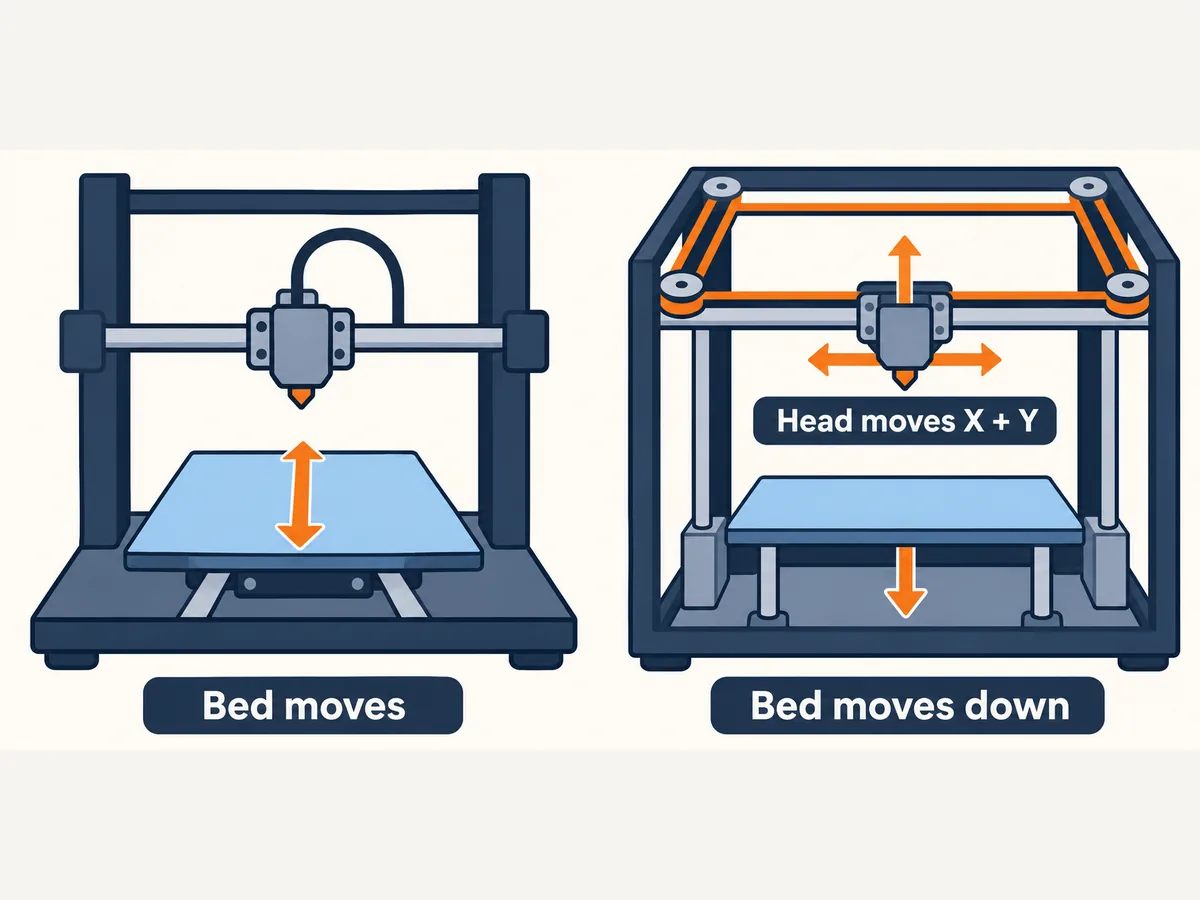
Bed slinger (Cartesian). The bed moves front to back (Y), the print head moves left to right (X), and the gantry moves up (Z). The Bambu Lab A1 and A1 mini and the Prusa MK4S work this way. Prusa's own comparison table labels the MK4S "Cartesian".
- Simple and proven; usually cheaper.
- Needs clear space in front of and behind the printer for the bed to travel. The A1's stated footprint is 465 × 410 × 430 mm for a 256 mm bed.
- Tall, thin prints can wobble as the bed moves.
- Hard to enclose neatly because the bed sticks out.
CoreXY. The print head moves in X and Y on two belts; the bed only moves down as the print grows. Prusa labels the CORE One+ CoreXY, and Elegoo describes the Centauri Carbon 2 as CoreXY.
- The printer is a fixed box, so it is easy to enclose.
- The heavy bed is not thrown about, which suits fast printing.
- Usually costs more, and belts need tensioning as per the manual.
Neither is "better" for every buyer. For PLA and PETG on a budget, a good bed slinger is fine. For ABS, ASA and nylon, an enclosed CoreXY is the usual choice.
How much build volume do you need?
Build volume is the largest box a single print can fill: width × depth × height. Common sizes on the printers we checked:
| Printer | Stated build volume |
|---|---|
| Bambu Lab A1 mini | 180 × 180 × 180 mm |
| Prusa MK4S | 250 × 210 × 220 mm |
| Prusa CORE One+ | 250 × 220 × 270 mm |
| Bambu Lab A1, P1S | 256 × 256 × 256 mm |
| Elegoo Centauri Carbon 2 | 256 × 256 × 256 mm |
| Sovol SV08 | 350 × 350 × 345 mm |
Sources: makers' pages listed at the end of this guide, checked 15 November 2026. Bambu notes that Bambu Studio defaults the P1S's printable height to 250 mm to protect the bed.
Rules of thumb:
- 180 mm handles most desk tidies, phone stands, small figures and replacement parts.
- About 250 mm handles bigger enclosures, plant pots and larger figures.
- Anything bigger can usually be split into parts and glued, which is how most cosplay helmets are printed on desktop machines. Only buy a large printer if you need large single pieces: big beds take longer to heat and use more power.
Putting it together
| Your plan | Good match |
|---|---|
| PLA and PETG, small space, tight budget | Open bed slinger with a 180–256 mm bed |
| PLA and PETG, bigger parts | Open bed slinger or open CoreXY with about 256 mm |
| ABS, ASA, nylon | Enclosed CoreXY, ideally with filtration, in a ventilated room |
| A bit of everything | Enclosed CoreXY that lets you open the door for PLA |
See our best 3D printers UK for models in each group and filament types explained for what each material needs.
Can I add an enclosure to an open printer later?
Some makers sell one. Prusa offers an optional enclosure with a filtration add-on for the MK4S, and lists ABS, ASA, HIPS and nylon as supported only when it is fitted. Bambu Lab does not recommend ABS or ASA on the A1 series. Follow the maker's guidance rather than building your own box.
Do enclosed printers use more electricity?
Not necessarily. Prusa states 80 W with PLA settings for the open MK4S and 90 W for the enclosed CORE One+, which are close. Heated chambers and hot beds for ABS draw more. Our print cost calculator lets you enter your own figure.
Sources
Opened and checked on 15 November 2026.
- uk.store.bambulab.com/products/p1s
- uk.store.bambulab.com/products/a1
- uk.store.bambulab.com/products/a1-mini
- uk.store.bambulab.com/products/abs-filament
- www.prusa3d.com/product/prusa-core-one/
- www.prusa3d.com/product/original-prusa-mk4s-3d-printer-5/
- uk.elegoo.com/products/centauri-carbon-2
- health-safety.ed.ac.uk/guidance/hazardous-substances/3d-printers
- prusament.com/materials/prusament-asa/
- prusament.com/materials/prusament-pa11/
- www.sovol3d.com/products/sovol-sv08-3d-printer