Guides · Buying a printer
Bambu Lab A1 vs Prusa MK4S: a spec-by-spec comparison for UK buyers
The Bambu Lab A1 and Prusa MK4S compared on build volume, temperatures, materials, calibration, multi-colour, software, warranty and UK price, using each maker's published specifications checked on 15 November 2026.
We haven't tested these products. This comparison is based on makers' published specifications and manuals, retailer listings and owner reviews (checked 15 November 2026).
The Bambu Lab A1 and the Prusa MK4S are both open-frame "bed slinger" printers, where the bed moves front to back and the print head moves side to side. That is where most of the similarity ends. The A1 is a low-priced, highly automated printer with an optional four-colour feeder. The MK4S is a more expensive, repair-friendly machine from a company that publishes its designs and sells spares directly. This page compares them using only what each maker publishes.
Specifications side by side
| Bambu Lab A1 | Prusa MK4S | |
|---|---|---|
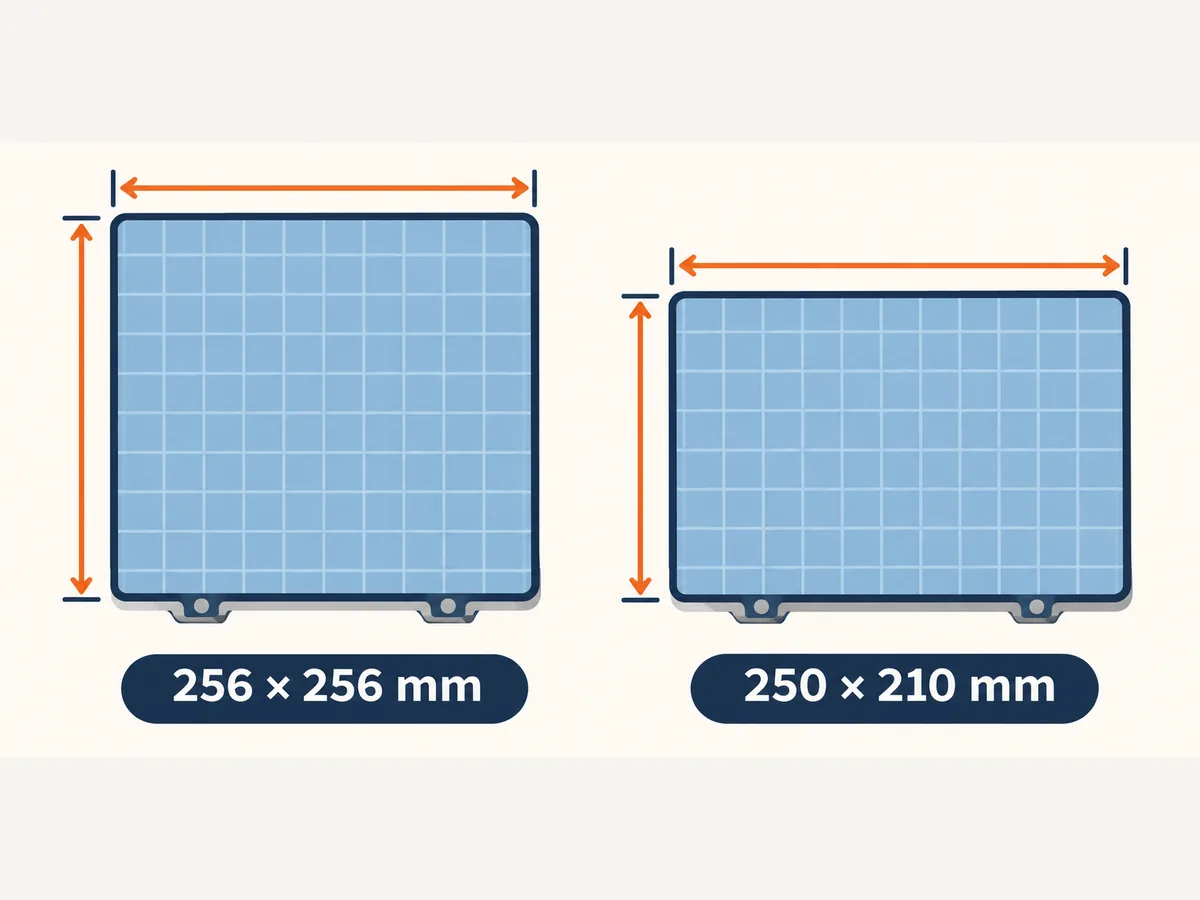
| Build volume | 256 × 256 × 256 mm | 250 × 210 × 220 mm |
| Max nozzle temperature | 300 °C | 290 °C |
| Max bed temperature | 100 °C | 120 °C |
| Nozzle | Stainless steel, 0.4 mm included (0.2, 0.6, 0.8 mm options) | High-flow Prusa Nozzle brass CHT 0.4 mm |
| Bed levelling | Full-auto calibration | Loadcell sensor, automatic mesh bed levelling |
| Print surface | Bambu Textured PEI plate included | Magnetic heatbed with removable PEI spring steel sheets |
| Ideal materials | PLA, PETG, TPU, PVA | PLA, PETG, flex, PVA, PC, PP, CPE, PVB |
| ABS, ASA, nylon | "Not recommended" | With the optional enclosure and filtration add-on |
| Multi-colour | AMS lite, up to 4 colours | MMU3 (up to 5 filaments) |
| Power | Not stated on the page we opened | 80 W PLA settings, 120 W ABS settings; 240 W PSU |
| Weight | 8.3 kg net | 7 kg |
| UK warranty (maker store) | 1 year listed on the UK store | 1 year for the UK ("rest of the world") |
| Price checked 15 November 2026; sale prices change | Around £189, UK store | Assembled around $999 in US dollars on the page we opened |
Sources: the A1 specifications on Bambu Lab's UK store, the Bambu Lab UK printers page, the Prusa MK4S product page, Prusa's comparison table on the CORE One+ page and Prusa's warranty page.
Price and what you get for it
On 15 November 2026 the A1 was around £189 in Bambu Lab's sale; sale prices change. The Prusa page we opened showed an assembled price around $999 in US dollars. Prusa ships to the UK, but check the checkout total in pounds, and read the GOV.UK guidance on tax and duty for goods sent from abroad: for goods over £135 you may pay import VAT, and possibly duty, to the delivery company before delivery. Our UK buying guide explains how that works.
On price alone the A1 wins by a wide margin. The question is whether the MK4S's extras are worth several times as much to you.
Where the A1 is stronger
- Build volume. 256 mm in every direction against 250 × 210 × 220 mm. Taller prints in particular fit better on the A1.
- Multi-colour cost. The AMS lite was around £139 on its own (checked 15 November 2026; sale prices change) and is built for the A1 and A2 series. It feeds up to four spools.
- Hands-off setup. Bambu lists full-auto calibration, a filament tangle sensor, filament odometry and a camera.
- Price. It is a fraction of the MK4S price on the day we checked.
Where the MK4S is stronger
- Materials. A 120 °C bed and an optional enclosure with filtration open up ABS, ASA, HIPS and nylon. Bambu does not recommend those on the A1.
- Repairability and openness. Prusa sells spare parts directly, publishes printer handbooks, and its PrusaSlicer is free, open source and works without an account. Bambu Studio is also open source (licensed under the AGPL, per its GitHub page) and is based on PrusaSlicer.
- Kit option. You can buy the MK4S as a kit and learn the machine as you build it.
- Known power figures. Prusa states 80 W with PLA settings, which helps if you care about running costs. Use our print cost calculator to see what that means per print.
Warranty and support in the UK
Bambu Lab's UK store lists a one-year warranty, 30-day returns and shipping from a UK warehouse. Prusa's warranty page gives two years to consumers in the EU, Liechtenstein, Switzerland, Norway and Iceland, and one year to "the rest of the world", which includes the UK; it also sells warranty extensions of one or two years for the MK4S if bought with the printer. Your statutory rights under UK consumer law apply on top of either warranty when you buy from a UK seller; see buying a 3D printer in the UK.
Which should you choose?
- Choose the A1 if you mainly want PLA and PETG, like the idea of four-colour prints, want the lowest cost and are happy with a mostly sealed, automated system.
- Choose the MK4S if you want to print ABS or ASA later with an enclosure, value repairability and open software, or simply enjoy understanding the machine.
- Consider the enclosed alternatives in best 3D printers UK if you want ABS and ASA from day one: the Bambu Lab P1S, Prusa CORE One+ and Elegoo Centauri Carbon 2 are all enclosed.
Is the MK4S quieter than the A1?
Neither page we opened gave a like-for-like noise figure for both printers, so we cannot compare them fairly. Bambu quotes under 48 dB in silent mode for the smaller A1 mini only.
Can the A1 print ABS if I build a box around it?
Bambu lists ABS and ASA as "not recommended" on the A1. A home-made enclosure does not change the maker's guidance, and ABS gives off more fumes than PLA. If you need ABS, choose a printer the maker supports for it.
Sources
Opened and checked on 15 November 2026.
- uk.store.bambulab.com/products/a1
- uk.store.bambulab.com/collections/3d-printers
- uk.store.bambulab.com/products/ams-lite
- www.prusa3d.com/product/original-prusa-mk4s-3d-printer-5/
- www.prusa3d.com/product/prusa-core-one/
- help.prusa3d.com/article/warranty_2288
- www.prusa3d.com/p/prusaslicer/
- github.com/bambulab/BambuStudio
- www.gov.uk/goods-sent-from-abroad/tax-and-duty