3D Printer Guide
3D printing glossary
Plain-English definitions of 3D printer and filament terms, from AMS and bed slinger to Z offset, with links to the guides that explain them.
A
ABS
Acrylonitrile butadiene styrene. A heat-resistant but warp-prone filament that is best printed in an enclosure with ventilation. See filament types explained.
AMS
Automatic Material System: Bambu Lab's name for its multi-spool feeders. The AMS lite holds four spools and works only with the A1 and A2 series, according to Bambu Lab. See multi-colour 3D printing.
ASA
Acrylonitrile styrene acrylate. Similar to ABS with better UV resistance; Prusa describes its Prusament ASA as UV stable and suited to outdoor use.
Auto bed levelling
The printer probes points across the bed and compensates for unevenness while printing. See first print checklist.
B
Bed slinger
A printer whose bed moves back and forth on the Y axis, such as the Bambu Lab A1 or Prusa MK4S. See enclosed vs open printers.
Brim
A flat ring of extra lines printed around the base of a part to help it stick and resist warping. It is trimmed off afterwards.
Build volume
The largest width × depth × height a printer can print in one piece, for example 256 × 256 × 256 mm on the Bambu Lab A1.
C
CFS
Creality Filament System, Creality's multi-colour feeder for the K2 series. Creality says four units allow up to 16 colours on its K2 page.
CoreXY
A motion system where two belts move the print head in X and Y while the bed only moves down. Common on enclosed printers such as the Prusa CORE One+.
Creative Commons
A family of licences used on many model sites. "NC" means non-commercial use only. See Creative Commons' licence guide and slicers and model sites.
D
Density
Mass per unit volume, in g/cm³. It decides how many metres are on a 1 kg spool. Polymaker's technical data lists PolyLite PLA at 1.17 and PolyLite ABS at 1.04.
Desiccant
A moisture-absorbing material, usually silica gel, used in sealed filament boxes. See storing and drying filament.
Direct drive
An extruder mounted on the print head, right above the nozzle. Prusa describes the MK4S's Nextruder as direct drive.
E
Enclosure
A box around the print area that keeps heat in and hands out. Recommended or required for ASA, ABS and nylon.
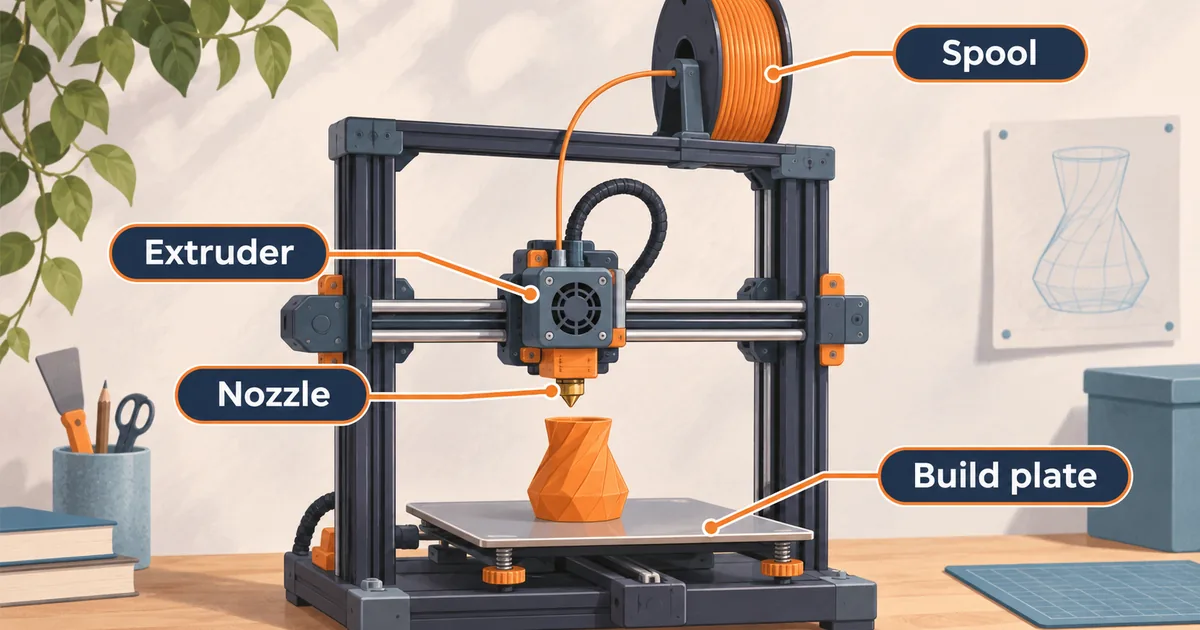
Extruder
The motor and gears that push filament into the hot end.
F
FDM / FFF
Fused deposition modelling or fused filament fabrication: printing by melting filament and laying it down layer by layer. Every printer on this site is FDM.
Filament
The plastic wire fed into an FDM printer, usually 1.75 mm thick on 1 kg spools.
First layer
The bottom layer of a print. Most failed prints start here. See first print checklist.
G
G-code
The list of machine instructions a slicer produces for the printer to follow.
H
Heated bed
A build plate that warms up to help prints stick. Bambu lists an 80 °C maximum on the A1 mini; Prusa lists 120 °C on the MK4S.
Hot end
The heated part that melts filament, including the nozzle and heat break.
Hygroscopic
Absorbs moisture from the air. Prusa lists ASA and nylon as hygroscopic. See storing and drying filament.
I
Infill
The internal pattern that fills a print's inside. Lower infill saves filament and time.
Input shaping
Firmware that reduces ringing ("ghosting") caused by vibration at speed. Prusa lists input shaper on the MK4S and CORE One+.
L
Layer height
The thickness of each layer, often 0.2 mm. Prusa lists 0.05–0.30 mm on the MK4S.
Loadcell
A force sensor. Prusa uses one in the print head to find the bed surface for first-layer calibration.
N
Nozzle
The small brass or steel tip filament comes out of, usually 0.4 mm. Abrasive filaments need hardened nozzles.
P
PEI
Polyetherimide, a common build plate surface that holds prints when hot and releases them when cool.
PETG
A tough, glossy, slightly flexible filament. See PLA vs PETG.
PLA
Polylactic acid, the easiest and most common filament. See best PLA filament UK.
R
Retraction
Pulling filament back briefly during travel moves to reduce stringing.
RFID filament tag
A chip on some spools that lets a printer or feeder identify the material and colour automatically, as on Bambu Lab's own filament.
S
Slicer
Software that turns a 3D model into G-code. Bambu Studio is, per its GitHub page, based on PrusaSlicer. See slicers and model sites.
Stringing
Thin hairs of plastic between parts of a print, often caused by wet filament or high temperatures.
Supports
Temporary structures printed under overhangs, removed after printing.
T
TPU
Thermoplastic polyurethane, a flexible filament. "95A" is its Shore hardness. See Prusament TPU 95A.
U
Ultrafine particles (UFPs)
Particles smaller than 100 nanometres. FDM printers release them, and UL Research Institutes found particle emissions are sensitive to printing conditions. See 3D printer safety.
V
VOCs
Volatile organic compounds: gases and vapours released from heated plastic. Emissions vary by material, per UL Research Institutes.
W
Warping
Corners lifting off the bed as plastic cools and shrinks. Worse with ABS and ASA.
Z
Z offset
The fine gap between nozzle and bed at the start of printing. Too high and the first layer will not stick; too low and the nozzle scrapes.
Sources
Opened and checked on 15 November 2026.
- uk.store.bambulab.com/products/ams-lite
- uk.store.bambulab.com/products/a1-mini
- www.prusa3d.com/product/original-prusa-mk4s-3d-printer-5/
- www.prusa3d.com/product/prusa-core-one/
- prusament.com/materials/prusament-asa/
- prusament.com/materials/prusament-tpu-95a/
- wiki.polymaker.com/polymaker-products/polymaker-filaments/technical-data-at-a-glance
- github.com/bambulab/BambuStudio
- creativecommons.org/cc-licenses/
- ul.org/publications/comprehensive-emissions-data-from-material-extrusion-3d-printing-now-available/
- store.creality.com/uk/products/creality-k2-combo-3d-printer