Guides · Safety
3D printer safety at home: fumes, ultrafine particles and fire risk
What research from UL Research Institutes, NIOSH and HSE-based university guidance says about 3D printer emissions, how to ventilate, which filaments emit more, and electrical and fire safety advice from the London Fire Brigade.
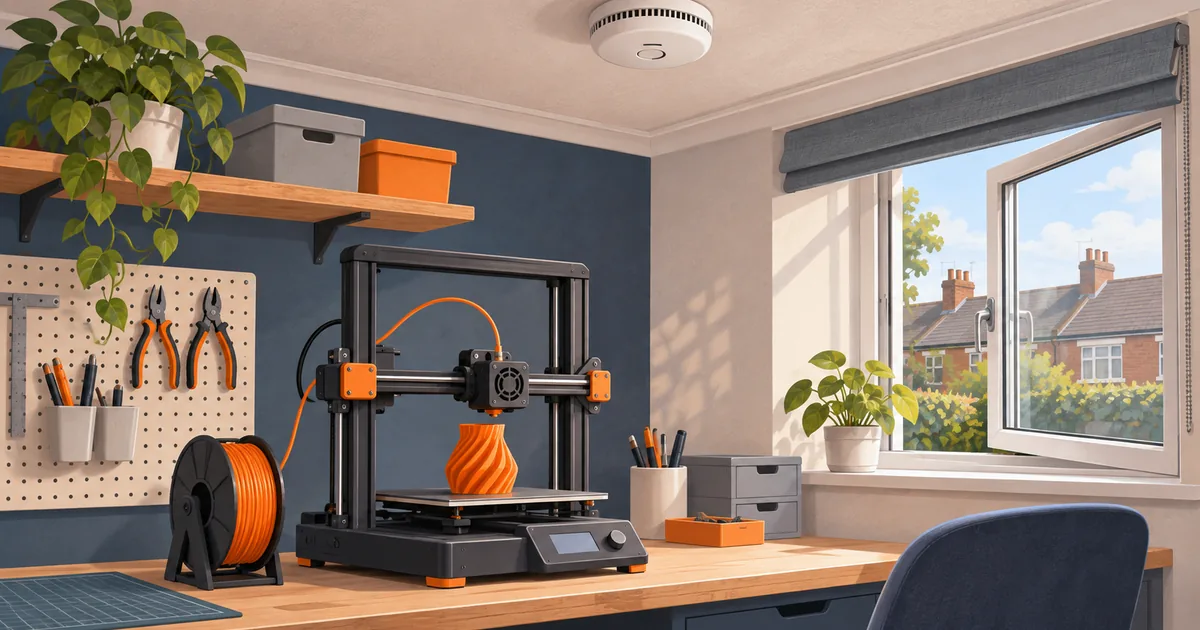
A desktop 3D printer melts plastic at 200 °C or more for hours at a time. That brings two kinds of risk you should plan for before you choose a room: what comes off the hot plastic (particles and vapours), and the heat and electricity themselves. The good news is that sensible choices of room, material and habits reduce both a lot. This guide summarises what credible sources say. Your printer's manual takes priority.
What comes off a printer
When filament melts it releases ultrafine particles (UFPs, tiny particles under 100 nanometres) and volatile organic compounds (VOCs, gases and vapours). How much depends on the material, the temperature and the printer.
The Chemical Insights Research Institute of UL Research Institutes published a consolidated analysis of more than 500 exposure studies on filament (material extrusion) printing. Its summary says:
- emission characteristics are affected by filament material and print conditions;
- high-emitting materials include nylon (for particles), ASA, ABS and HIPS;
- VOCs emitted included chemicals known to be carcinogens, irritants, and developmental and reproductive toxins;
- particle emissions are more sensitive to printing conditions than VOC emissions;
- exposure "may exceed recommended limits", so users should take measures to reduce exposure.
The US National Institute for Occupational Safety and Health (NIOSH) has published Approaches to Safe 3D Printing, a guide for makerspaces, schools, libraries and small businesses, which is a useful deeper read.
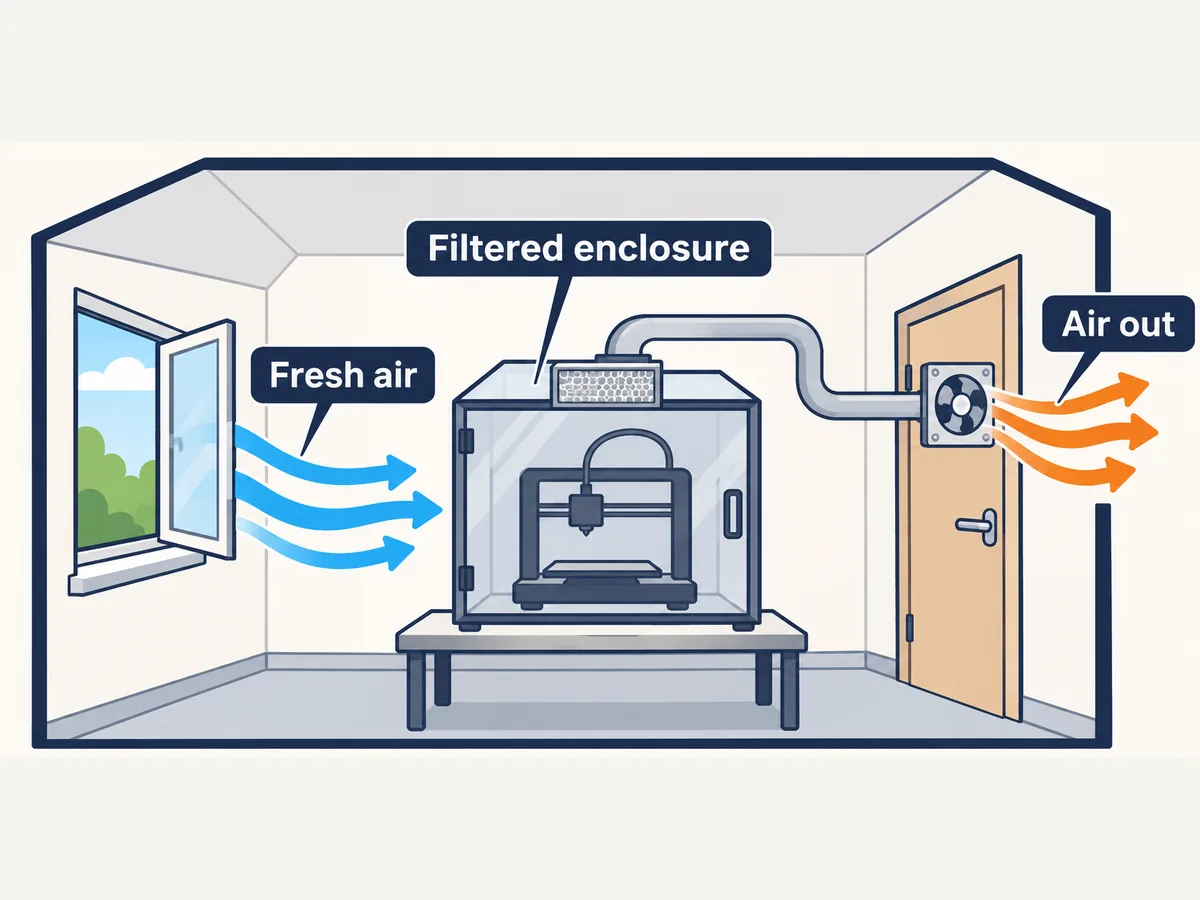
In the UK, the University of Edinburgh's 3D printer guidance bases its recommendations on HSE research (IRR146) and says there is no newer HSE research to the contrary. It reports that in HSE laboratory work a filtered enclosing hood reduced particle emissions released to the room by 97% when exhausting air and 99% when recirculating, and it recommends a clearance time before opening an enclosure after printing. It also says: wherever possible, use PLA to reduce the risk from fumes and particles.
Practical ways to reduce exposure at home
- Choose the material. PLA for most prints. Use ABS, ASA and nylon only when you need their properties, and in better-ventilated spaces. Bambu Lab's ABS page recommends an enclosed printer and a well-ventilated area or effective filtration, warns ABS may release styrene that can cause dizziness or nausea, and suggests increasing ventilation if people with asthma or respiratory conditions, pregnant women or children are present. Prusa's ASA page notes ASA contains styrene and produces odours, and its PA11 page recommends an enclosure with active filtration.
- Choose the room. A room with an openable window, not a bedroom, and not a small room people spend all day in.
- Ventilate. Fresh air in and out, especially for ABS and ASA. Avoid blasting a draught across the printer itself, which can spoil prints; ventilate the room.
- Use an enclosure and filter where the maker supports one. Elegoo lists a HEPA plus activated carbon filter on the Centauri Carbon 2, for example. After a print, give the enclosure time before opening it.
- Do not stand over it. Watch the first layer, then step away.
- Keep children and pets away from the printer while it runs and while the nozzle and bed cool.
Some filaments carry emissions certifications. Bambu's PLA Basic page, for instance, says it is certified to UL GREENGUARD 2904 for low indoor printing emissions. That is useful information, but it does not remove the need for ventilation.
Heat, fire and electrical safety
There is little UK guidance written specifically about 3D printers, so the safest approach is to treat a printer like any other high-powered, heat-producing appliance.
The London Fire Brigade's electrical items advice says electrical items are the number 4 fire risk in the home, and that the Brigade has attended 26,376 electrical fires in London since 2017. Its must-knows include:
- make sure electrical appliances have a British or European safety mark when you buy them;
- keep appliances clean and in good working order;
- try to keep to one plug per socket, especially for high-powered appliances, and do not overload extension leads (fully unwind cable drum leads);
- watch for scorch marks, flickering lights, hot plugs and sockets, and fuses or breakers that trip for no obvious reason – these can be signs of dangerous wiring.
For 3D printers specifically, sensible habits are:
- Do not leave a printer running unattended, especially a new printer, a long print or one you have modified. Do not run it overnight while you sleep or while you are out.
- Fit a working smoke alarm in the room and test it.
- Keep the area clear of paper, fabric, solvents and spare filament.
- Check cables and connectors at the heated bed and hot end for damage, as the manual describes, and stop using a printer with scorched or loose connections.
- Use the maker's power supply and leads, and keep firmware updated.
- Use a camera or app to check in if your printer has one (Bambu lists a camera on the A1 mini), but a camera is not a substitute for being nearby.
Any electrical repair beyond swapping a maker-supplied part should be done by a competent person. If a printer smokes or smells of burning, switch it off at the wall if it is safe to do so. If there is a fire, get out, stay out and call 999.
Burns, sharp edges and chemicals
- Nozzles run at 200–300 °C and beds at up to about 100–120 °C on the printers we checked. Let them cool before touching.
- Use the tools supplied for removing supports, and cut away from your hand.
- Some post-processing (for example acetone vapour smoothing of ABS or ASA) brings its own chemical hazards. Follow the chemical's safety data sheet and the maker's guidance.
Food contact
Do not assume a print is food-safe. Bambu says its ABS is not food-grade and should not be used for food storage or contact. Layer lines can trap bacteria even if the plastic itself is suitable. Check the filament maker's guidance for any food-contact use.
Is PLA completely safe to print indoors?
No material is emission-free. UL Research Institutes' findings and the HSE-based Edinburgh guidance both point to PLA as a lower-emission choice than ABS, ASA or nylon, which is why it is recommended where possible. Ventilate anyway.
Does an air purifier help?
A purifier with suitable filters may reduce particles in a room, but the HSE-based results above are for a filtered enclosure around the printer, which captures emissions at the source. Ventilation and a lower-emission material remain the first steps.
Sources
Opened and checked on 15 November 2026.
- ul.org/publications/comprehensive-emissions-data-from-material-extrusion-3d-printing-now-available/
- www.cdc.gov/niosh/publications/numbered/2024-103.html
- health-safety.ed.ac.uk/guidance/hazardous-substances/3d-printers
- www.london-fire.gov.uk/safety/the-home/electrical-items/
- uk.store.bambulab.com/products/abs-filament
- uk.store.bambulab.com/products/pla-basic-filament
- prusament.com/materials/prusament-asa/
- prusament.com/materials/prusament-pa11/
- uk.elegoo.com/products/centauri-carbon-2
- uk.store.bambulab.com/products/a1-mini