Guides · Filament
3D printer filament types explained: PLA, PETG, ABS, ASA, TPU and nylon
What each common FDM filament is good for, the nozzle and bed temperatures makers state for it, how much it warps and fumes, and which printers handle it, with sources checked on 15 November 2026.
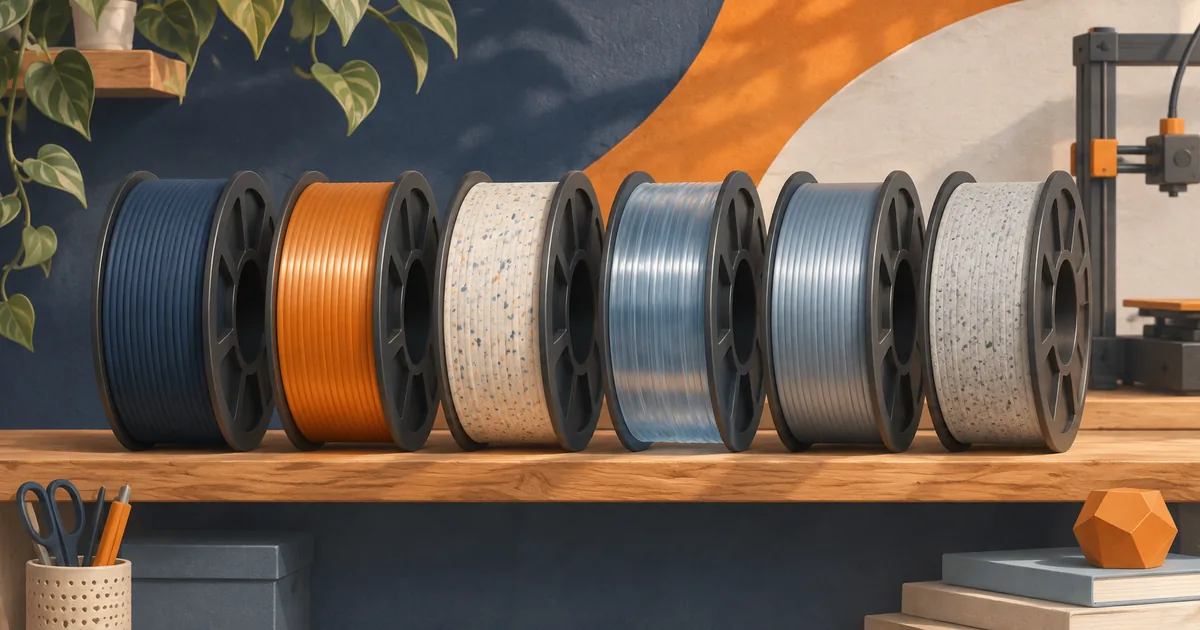
Filament is the plastic your printer melts. Each type behaves differently: some are easy and stiff, some tough, some heat-resistant, some rubbery. Picking the right one matters more than most printer settings. This guide covers the six materials most home users meet, with temperatures as the makers state them. Always use the figures printed on your own spool first.
PLA: the default
PLA (polylactic acid) is the easiest common material and the one most beginners should use first.
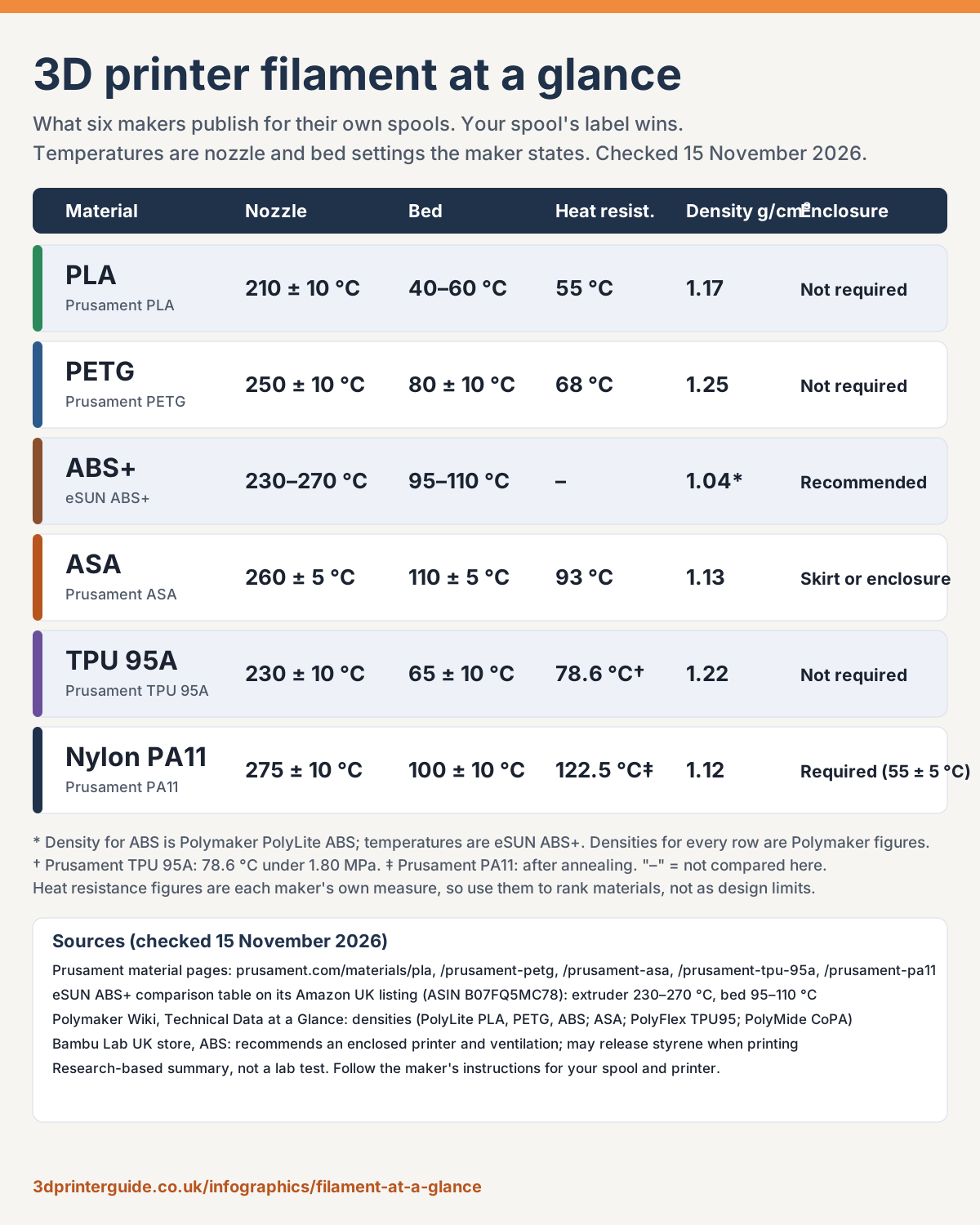
- Temperatures: Prusa lists 210 ± 10 °C at the nozzle and a 40–60 °C bed for Prusament PLA, with no enclosure required and the part cooling fan at 100%.
- Strengths: prints fast and detailed, barely warps (Prusa rates warping "None"), little or no smell.
- Weaknesses: softens at fairly low temperatures. Prusa gives a temperature resistance of 55 °C, so PLA parts can deform in a hot car or near a radiator.
- Use for: models, figures, desk items, prototypes, most household bits.
PETG: tougher and more heat-resistant
PETG is a glycol-modified polyester, the same family as many drinks bottles.
- Temperatures: Prusament PETG lists 250 ± 10 °C nozzle and 80 ± 10 °C bed, enclosure not required, fan at 50%.
- Strengths: Prusa rates its toughness "high" and gives 68 °C temperature resistance. Low warping.
- Weaknesses: can string, and some PETG sticks very strongly to smooth PEI. Follow your plate maker's advice (some recommend glue stick as a release layer).
- Use for: functional parts, brackets, outdoor items that do not see much heat, containers.
We compare these two in detail in PLA vs PETG.
ABS: heat-resistant, but fussier
ABS (acrylonitrile butadiene styrene) is the plastic in many household products.
- Temperatures: maker ranges vary widely. The comparison table on the eSUN ABS+ listing (around £13.59 for 1 kg, checked 15 November 2026; sale prices change) gives 230–270 °C extruder and 95–110 °C bed. Check your spool.
- Strengths: higher heat resistance than PLA or PETG, can be smoothed with acetone vapour.
- Weaknesses: warps in cold or draughty rooms, smells, and is among the higher-emitting materials in UL Research Institutes' data. Bambu Lab's ABS page recommends an enclosed printer plus ventilation or filtration, and warns ABS may release styrene.
- Printers: Bambu lists ABS as "not recommended" on the A1 series. Choose an enclosed printer the maker supports for ABS.
ASA: ABS for outdoors
ASA is similar to ABS but with better UV resistance.
- Temperatures: Prusament ASA lists 260 ± 5 °C nozzle, 110 ± 5 °C bed, with a skirt or enclosure recommended and the fan at 30%.
- Strengths: Prusa lists "great for outside use – UV stable" and 93 °C temperature resistance.
- Weaknesses: Prusa notes large models tend to warp, it produces odours (less than ABS), contains styrene and is hygroscopic.
- Use for: garden fittings, car accessories, anything outside in sun.
TPU: flexible
TPU (thermoplastic polyurethane) is rubbery. "95A" is a Shore hardness: flexible but not floppy.
- Temperatures: Prusament TPU 95A lists 230 ± 10 °C nozzle and 65 ± 10 °C bed.
- Strengths: high wear and impact resistance; Prusa says its TPU has very low moisture absorption and drying is usually not necessary.
- Weaknesses: prints slowly (Prusa rates print speed "Slow") and some multi-colour feeders do not handle it well.
- Use for: phone cases, bumpers, feet, gaskets, grips.
Nylon (polyamide, PA)
Nylon is strong and slippery, ideal for gears and hinges, but the hardest material in this list.
- Temperatures: Prusament PA11 lists 275 ± 10 °C nozzle, 100 ± 10 °C bed and an enclosure at 55 ± 5 °C, with a special sheet or separation layer.
- Strengths: Prusa lists high impact and wear resistance, a low friction coefficient and good chemical resistance.
- Weaknesses: Prusa rates it "Hard" to print, with high warping and high odour, and recommends an enclosure with active filtration. It is hygroscopic: Prusa recommends drying PA11 at 90 °C for 6–8 hours if you are unsure how long the bag has been open.
- Use for: gears, hinges, wear parts – once you have an enclosed printer and some experience.
Density and weight
Different materials weigh different amounts per metre. Polymaker's technical data table lists PolyLite PLA at 1.17 g/cm³, PolyLite PETG at 1.25, PolyLite ABS at 1.04, ASA at 1.13, PolyFlex TPU95 at 1.22 and PolyMide CoPA nylon at 1.12. A kilo of ABS is therefore a longer length of filament than a kilo of PLA. Our print cost calculator uses these figures to convert length into weight.
Speciality filaments
Silk, matte, glow-in-the-dark, wood-filled and carbon-fibre-filled versions are usually a base material (often PLA or PETG) with additives. Abrasive fills such as carbon or glass fibre need a nozzle that resists wear: Elegoo, for example, lists a brass-hardened steel nozzle on the Centauri Carbon 2, whose ideal materials include PLA-CF. Check your printer's supported materials list: Bambu lists carbon- and glass-fibre-reinforced polymers as "not recommended" on the A1.
Which should you start with?
- PLA until you can reliably print good first layers.
- PETG when you need tougher, more heat-tolerant parts.
- TPU when you need flexibility.
- ASA or ABS only with an enclosed printer and a ventilated room.
- Nylon last.
Whatever you buy, keep it dry: see storing and drying filament.
What do 1.75 mm and 2.85 mm mean?
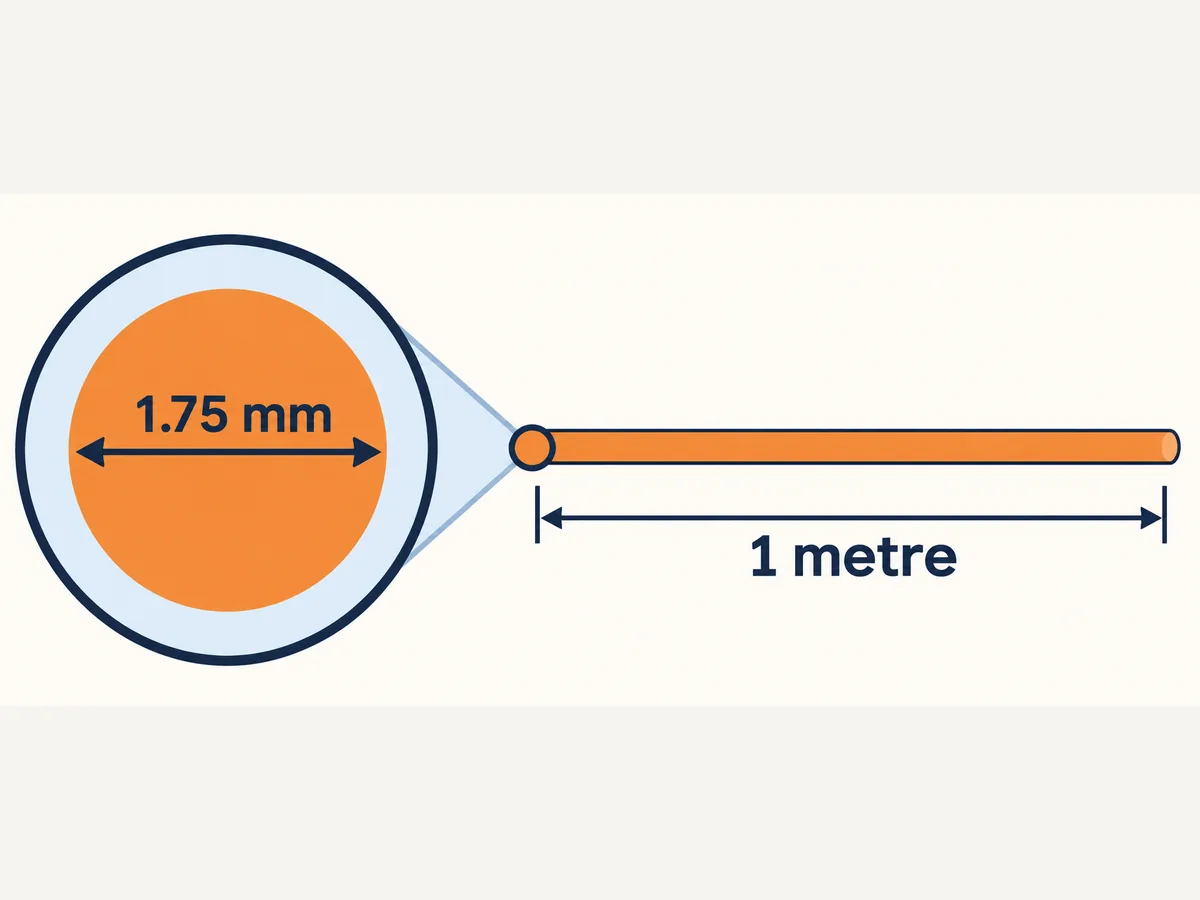
They are filament diameters. Most current desktop printers use 1.75 mm; Prusa and Elegoo both list 1.75 mm for the MK4S and Centauri Carbon 2. Buy the diameter your printer needs; they are not interchangeable.
What is PLA+ or "tough PLA"?
Maker-specific blends of PLA with additives meant to improve toughness. There is no single standard, so compare the maker's own data sheet rather than the name.
Sources
Opened and checked on 15 November 2026.
- prusament.com/materials/pla/
- prusament.com/materials/prusament-petg/
- prusament.com/materials/prusament-asa/
- prusament.com/materials/prusament-tpu-95a/
- prusament.com/materials/prusament-pa11/
- wiki.polymaker.com/polymaker-products/polymaker-filaments/technical-data-at-a-glance
- uk.store.bambulab.com/products/abs-filament
- uk.store.bambulab.com/products/pla-basic-filament
- uk.store.bambulab.com/products/a1
- ul.org/publications/comprehensive-emissions-data-from-material-extrusion-3d-printing-now-available/
- uk.elegoo.com/products/centauri-carbon-2
- www.prusa3d.com/product/original-prusa-mk4s-3d-printer-5/