Guides · Filament
Storing and drying 3D printer filament: keep spools dry in a UK home
Why filament absorbs moisture, the signs of a wet spool, how to store filament with sealed boxes and desiccant, and how to dry it safely using makers' temperatures, checked on 15 November 2026.
Most filaments slowly absorb water vapour from the air. Makers call this being hygroscopic. Prusa, for example, lists ASA as hygroscopic on its Prusament ASA page and says PA11 nylon "requires drying" on its PA11 page. Damp filament is one of the most common causes of poor prints that look like a settings problem.
Signs your filament may be wet
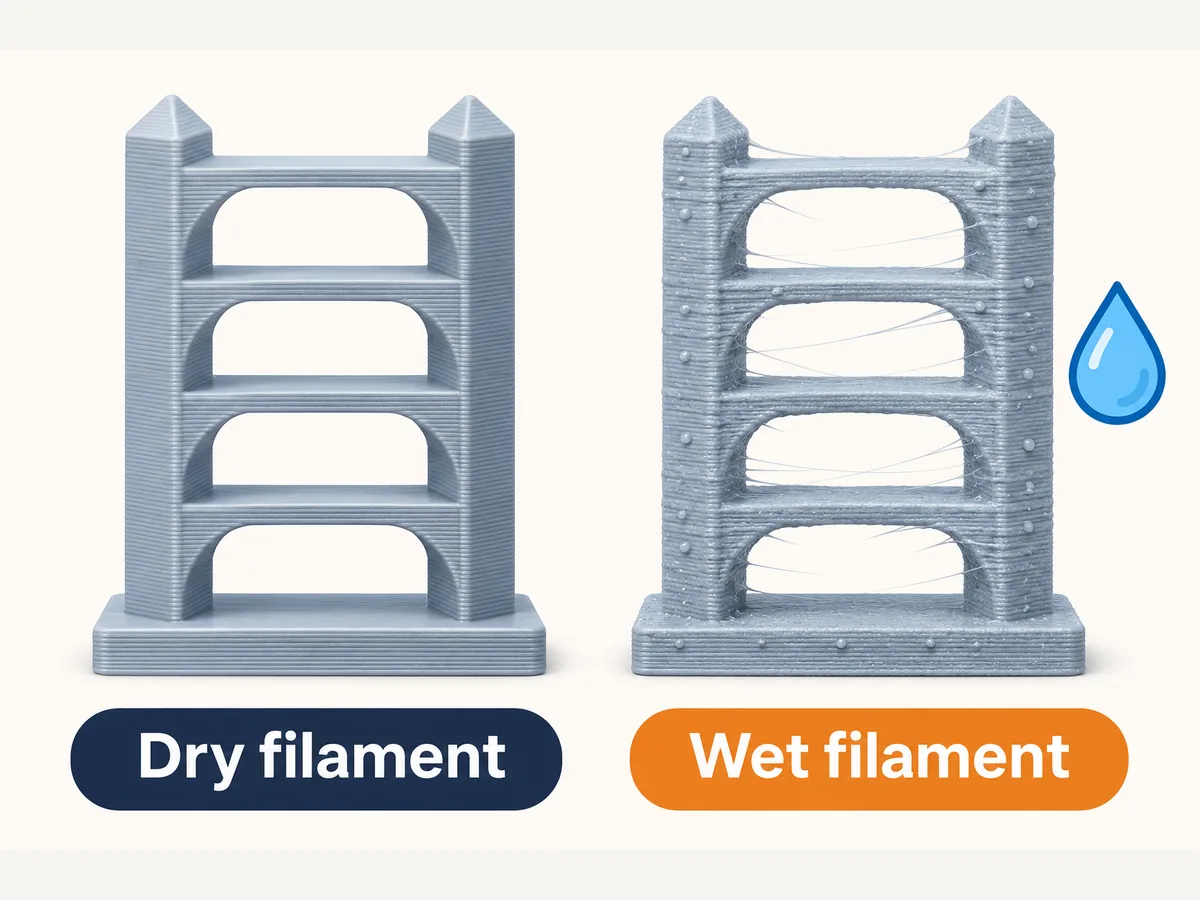
- Popping, crackling or hissing at the nozzle as water turns to steam.
- Lots of fine strings or "hairs" between parts.
- Rough, bubbly or dull surfaces where they are normally smooth.
- Weak, brittle parts, or filament that snaps easily on the spool.
These signs can have other causes too, such as temperature or retraction settings. Our sister site has a useful checklist: is my filament wet?
How filament arrives
New spools usually come vacuum-sealed with a desiccant sachet. Overture says on its Amazon UK listing that each spool is dried for 24 hours and vacuum-sealed; Elegoo says on its listing that its PLA is made in a dry, dust-free environment and vacuum-packed. Once you open the bag, the clock starts.
Storing filament
The goal is to keep open spools in low humidity between prints.
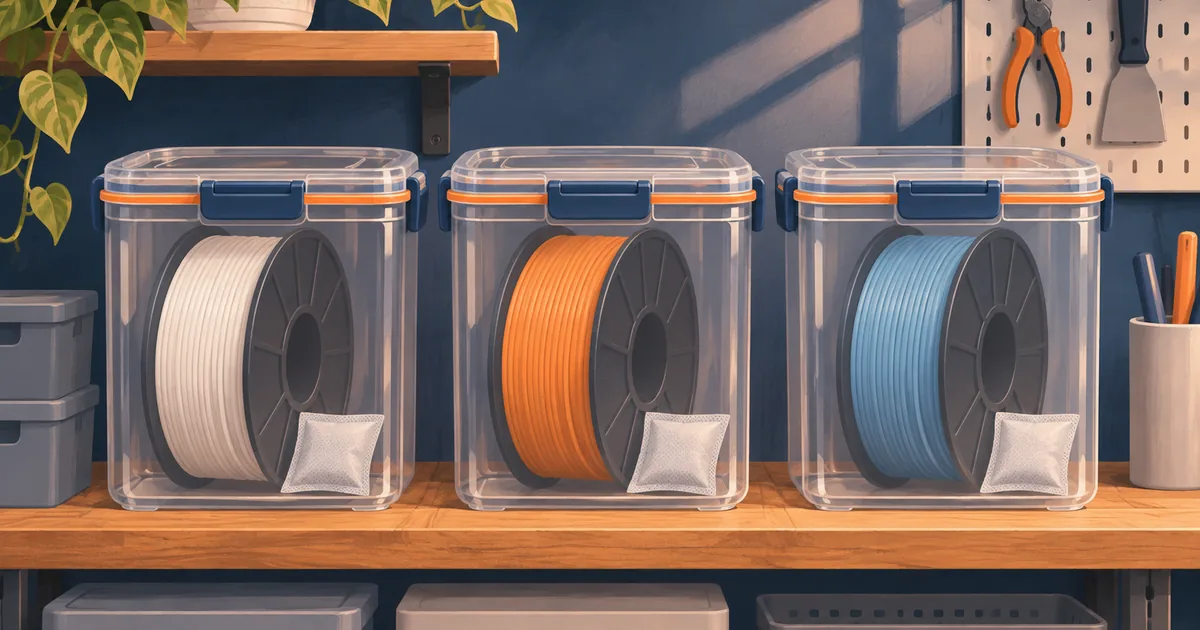
- Use an airtight box or bag. Purpose-made filament boxes work well. For example, the YOOPAI 4-pack filament storage boxes were around £21.99 on Amazon UK (checked 15 November 2026; sale prices change) and are described as four 4-litre containers with silicone-sealed flip lids, eight 50 g desiccant packs and labels. Vacuum bags with a pump are another option.
- Add desiccant. Silica gel sachets absorb moisture inside the box. Replace or regenerate them as their maker describes once they are saturated (many indicating types change colour).
- Add a cheap hygrometer if you want to see the humidity inside the box. It tells you when the desiccant needs attention.
- Label each box with material, colour and the date you opened it.
- Keep boxes somewhere cool and stable, not a damp garage or a sunny windowsill.
If you want storage and drying in one, Polymaker's PolyDryer Type A is a drying dock with separate sealed storage boxes, and eSUN's eBOX Lite doubles as a storage box you can print from. Our sister site's guide to filament storage humidity goes deeper on target readings.
Drying filament
Drying means holding the spool at a moderate temperature for several hours to drive moisture out.
- Use the filament maker's drying temperature and time. They differ by material and brand. Prusa recommends 90 °C for 6–8 hours for PA11 nylon if you are unsure how long the bag has been open; that is hotter than many consumer dryers reach.
- Do not exceed what the spool can take. Plastic spools can soften. If the maker's drying temperature is higher than the spool can stand, follow the maker's advice (some suggest re-spooling or using a different method).
- Not every material needs regular drying. Prusa says its TPU 95A has very low moisture absorption and that drying is usually not necessary, unless stored in high-moisture conditions.
- Use a dedicated filament dryer rather than a kitchen oven. See best filament dryer UK.
- Print from the dryer or a sealed box for long prints of moisture-sensitive materials, so the spool does not pick up water again during the print.
Which materials are most sensitive?
Makers' own pages give a good guide to how fussy each material is:
| Material | What the maker says | Practical storage |
|---|---|---|
| PLA | Prusa does not list PLA as hygroscopic on its Prusament PLA page | Sealed box once opened; dry if signs appear |
| PETG | Prusa does not flag drying on its Prusament PETG page | Sealed box; dry before long or important prints if it has been out |
| ASA | Prusa lists it as hygroscopic | Sealed box with desiccant; dry if it has been open a while |
| TPU 95A | Prusa says very low moisture absorption; drying usually not necessary | Sealed storage is still sensible in a damp room |
| Nylon (PA11) | Prusa says it requires drying; 90 °C for 6–8 hours if unsure | Dry before use and print from a dry box |
This is one maker's guidance for its own products. Other brands may differ, so check the label or data sheet on your spool.
Where to keep your boxes
A UK home varies a lot in humidity from room to room and season to season. Kitchens, bathrooms, utility rooms with tumble dryers, and unheated garages or sheds tend to be the dampest places. A heated spare room or a cupboard in a living area is usually better. Keep boxes off the floor of an outside wall where condensation can form, and away from radiators and direct sun, which can warm spools unevenly.
If your printer lives in a garage or shed, keep only the spool you are using near it and store the rest indoors in sealed boxes. Bring a spool indoors to warm up before opening its box in cold weather, so moisture does not condense on cold filament.
A simple routine
- Open a new spool only when you need it.
- After printing, return the spool to its sealed box with desiccant.
- If prints start stringing or popping, dry the spool before changing settings.
- Dry nylon and other strongly hygroscopic materials before every print session, following the maker.
How long can PLA be left out?
There is no single answer: it depends on the brand and how damp your room is. A spool that prints cleanly is fine; if you notice the signs above, dry it and store it sealed from then on.
Can I reuse desiccant?
Many silica gel products can be regenerated by heating, but follow the desiccant maker's instructions, as some types and packaging cannot be heated safely.
Sources
Opened and checked on 15 November 2026.
- prusament.com/materials/prusament-pa11/
- prusament.com/materials/prusament-asa/
- prusament.com/materials/prusament-tpu-95a/
- Amazon UK listing: YOOPAI Filament Storage Box 4 Pack with desiccant
- Amazon UK listing: Polymaker PolyDryer Type A
- Amazon UK listing: eSUN eBOX Lite Dryer Box
- Amazon UK listing: OVERTURE 3D Printer Filament PLA 1.75mm 1kg, Black
- Amazon UK listing: ELEGOO PLA Filament 1.75mm Black 1KG
- filamentdryinglab.co.uk/guides/is-my-filament-wet/
- filamentdryinglab.co.uk/guides/filament-storage-humidity/