Guides · Filament
PLA vs PETG: which filament should you use?
PLA and PETG compared on print temperatures, heat resistance, toughness, warping, stringing, drying and price, using Prusament, Polymaker and Amazon UK listings checked on 15 November 2026.
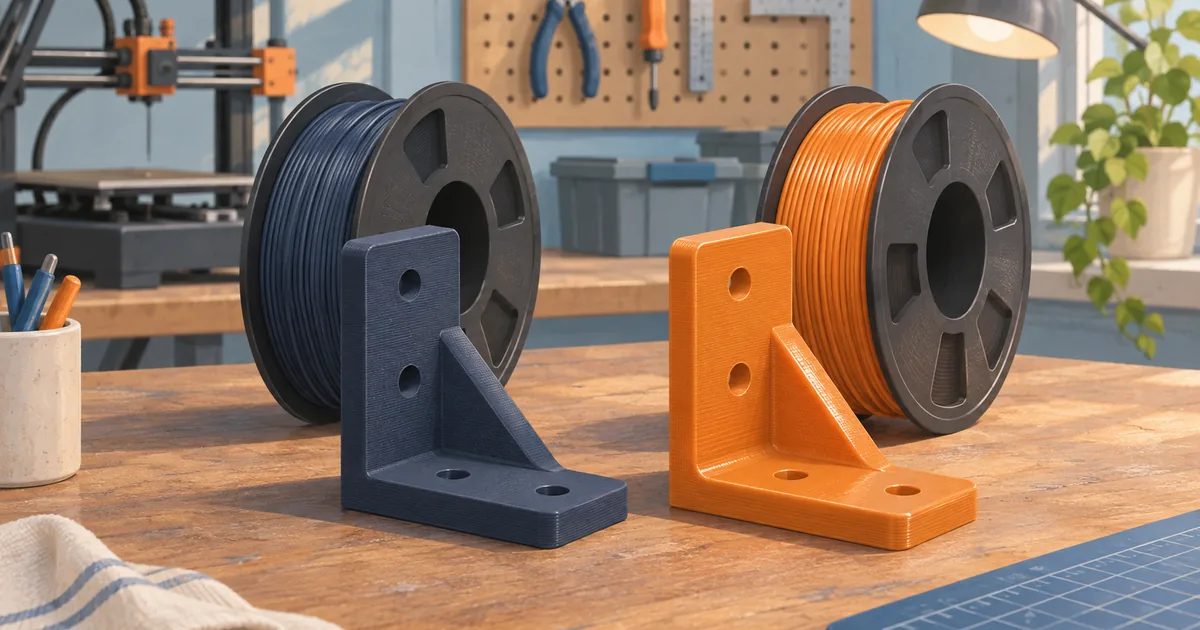
We haven't tested these products. This comparison is based on makers' published specifications and manuals, retailer listings and owner reviews (checked 15 November 2026).
PLA and PETG are the two filaments most home users choose between. Both print on almost any desktop printer without an enclosure. The short version: PLA is easier and crisper; PETG is tougher and copes with more heat. The detail below uses the makers' own figures so you can see where the line falls.
Side by side
| PLA | PETG | |
|---|---|---|
| Nozzle temperature (Prusament) | 210 ± 10 °C | 250 ± 10 °C |
| Bed temperature (Prusament) | 40–60 °C | 80 ± 10 °C |
| Part cooling fan (Prusament) | 100% | 50% |
| Temperature resistance (Prusament) | 55 °C | 68 °C |
| Toughness (Prusament rating) | Average | High |
| Warping (Prusament rating) | None | Low |
| Enclosure | Not required | Not required |
| Density (Polymaker PolyLite) | 1.17 g/cm³ | 1.25 g/cm³ |
| Typical 1 kg price, Amazon UK, 15 Nov 2026 | about £10–£13 | about £12–£13 |
Sources: Prusa's Prusament PLA and Prusament PETG pages, Polymaker's technical data table, and the Amazon UK listings linked below.
Choose PLA when
- You are learning. PLA is forgiving: low temperatures, almost no warping, and it bridges and overhangs well with full cooling.
- Looks and detail matter more than strength. Models, figures, display pieces, prototypes and cosplay parts.
- The part stays indoors and away from heat. Prusa's 55 °C temperature resistance figure means a PLA part can soften on a sunny car dashboard or near a radiator.
- You want the widest choice of colours and finishes, including silk and matte versions.
Budget examples on Amazon UK: eSUN PLA Basic 1 kg at around £9.99 and Elegoo PLA 1 kg at around £11.39 (checked 15 November 2026; sale prices change). More options are in best PLA filament UK.
Choose PETG when
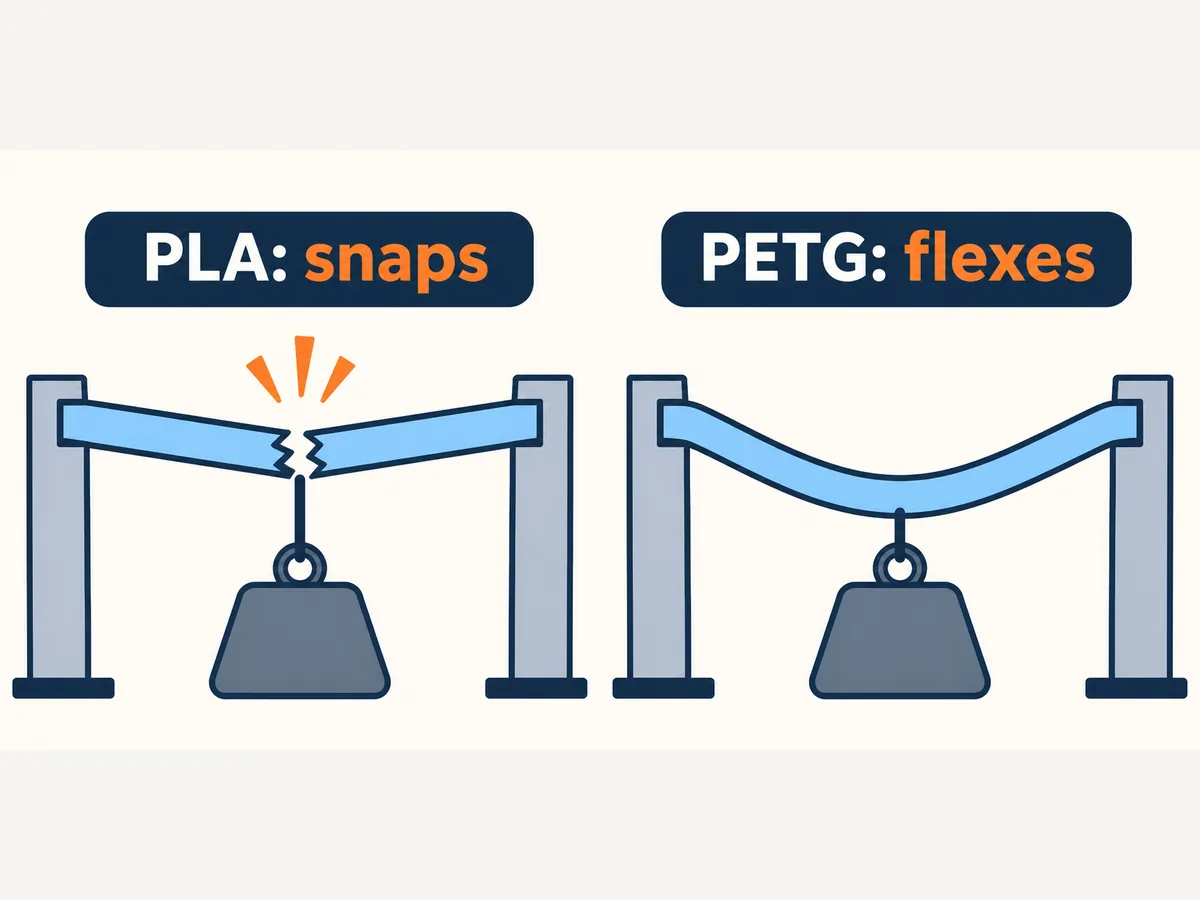
- The part has to take knocks or flex a little. Prusa rates PETG's toughness "high" against PLA's "average".
- It will get warm. 68 °C against 55 °C on Prusa's figures: not a huge gap, but useful for things like a car phone holder in a UK summer. For real heat, look at ASA (see filament types explained).
- It lives outdoors or near water. eSUN's PETG listing describes it as waterproof and weather- and chemical-resistant.
- You want a little gloss or translucency. eSUN's listing mentions excellent clarity and high gloss.
Examples on Amazon UK: eSUN PETG 1 kg at around £11.99 (eSUN quotes 350–355 m per 1 kg spool) and Sunlu PETG 1 kg at around £12.99 (checked 15 November 2026; sale prices change).
The practical differences when printing
Temperature and printer. PETG needs a hotter nozzle and bed. Any printer that reaches about 260 °C at the nozzle and 90 °C at the bed covers Prusa's PETG range. Bambu lists PETG as ideal on the A1 mini, whose bed tops out at 80 °C, so check your own maker's PETG profile rather than the generic figure.
Cooling. PLA wants the fan at full; Prusa runs PETG at 50%. Too much cooling on PETG can weaken layer bonding.
Stringing. PETG is more prone to fine strings between parts. Dry filament and tuned retraction help; slicer profiles from your printer's maker are a good start.
Bed adhesion. PETG can stick very strongly to some smooth PEI sheets. Follow your build plate maker's advice; some recommend glue stick as a release layer for PETG. Prusa lists PEI, glass, painter's tape and glue stick as print surfaces for both materials.
Moisture. Both absorb moisture from the air over time. Wet filament causes popping, stringing and rough surfaces. Store both sealed and dry them when needed: see storing and drying filament.
Speed. Both can print fast on modern printers; Prusa rates print speed "Fast" for each. High-speed versions of PLA exist, such as eSUN's "speedy" PLA Basic.
What about PLA+ and "tough" PLA?
Many brands sell PLA+ or "tough PLA", which sit between standard PLA and PETG. They are maker-specific blends with additives, so there is no single specification. If you need a bit more toughness but want PLA's easy printing, try one, and compare the maker's data sheet figures rather than the name on the box.
Fumes and safety
Neither appears in the list of high-emitting materials (nylon, ASA, ABS and HIPS) in UL Research Institutes' emissions summary, but both still give off particles and vapours. The University of Edinburgh's 3D printer guidance, based on HSE research, recommends using PLA wherever possible to reduce fumes and particles. Ventilate the room whichever you choose. See 3D printer safety.
Verdict
Start with PLA. Add a spool of PETG when you print something that needs to survive drops, a bit of flex or a warm windowsill. Many people keep both on hand and choose per part.
Can I switch between PLA and PETG without changing the nozzle?
Yes on most printers: load the new filament with the printer's load function at the higher temperature so the old material purges out. Select the correct filament profile in your slicer.
Is PETG food-safe?
Do not assume any print is food-safe. Layer lines can trap bacteria, and nozzles, colourants and additives vary. Check the filament maker's guidance for any food-contact use.
Which is cheaper per print?
On the prices we saw they are similar per kilo. PETG is denser (Polymaker lists 1.25 against 1.17 g/cm³), so the same model uses slightly more grams of PETG. Use the print cost calculator to compare.
Sources
Opened and checked on 15 November 2026.
- prusament.com/materials/pla/
- prusament.com/materials/prusament-petg/
- wiki.polymaker.com/polymaker-products/polymaker-filaments/technical-data-at-a-glance
- Amazon UK listing: eSUN PETG 3D Printing Filament 1.75mm, 1KG Spool, Solid Black
- Amazon UK listing: SUNLU PETG Filament 1.75mm Black
- Amazon UK listing: ELEGOO PLA Filament 1.75mm Black 1KG
- Amazon UK listing: eSUN PLA Basic Filament 1.75mm 1KG, Cold White
- uk.store.bambulab.com/products/pla-basic-filament
- uk.store.bambulab.com/products/a1-mini
- health-safety.ed.ac.uk/guidance/hazardous-substances/3d-printers
- ul.org/publications/comprehensive-emissions-data-from-material-extrusion-3d-printing-now-available/