Guides · Filament
Best filament dryer UK: Sunlu, Creality, eSUN and Polymaker compared
Five filament dryers on Amazon UK compared on stated temperature range, timer, heating and capacity, with prices checked on 15 November 2026, plus which materials need more heat than most dryers reach.
We haven't tested these products. This comparison is based on makers' published specifications and manuals, retailer listings and owner reviews (checked 15 November 2026).
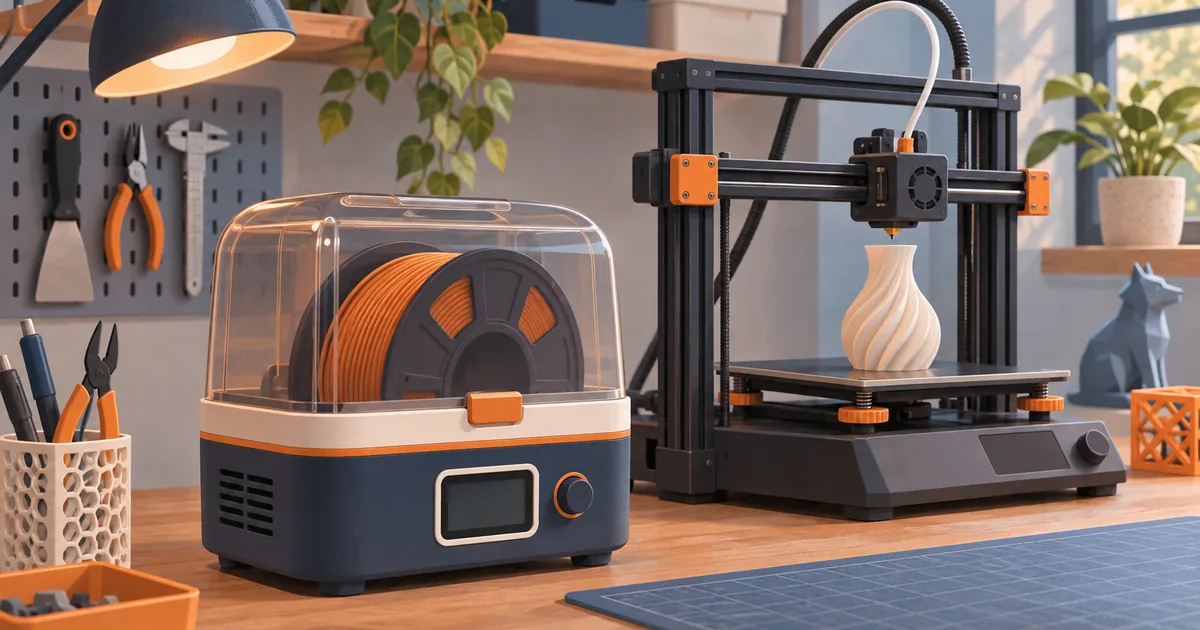
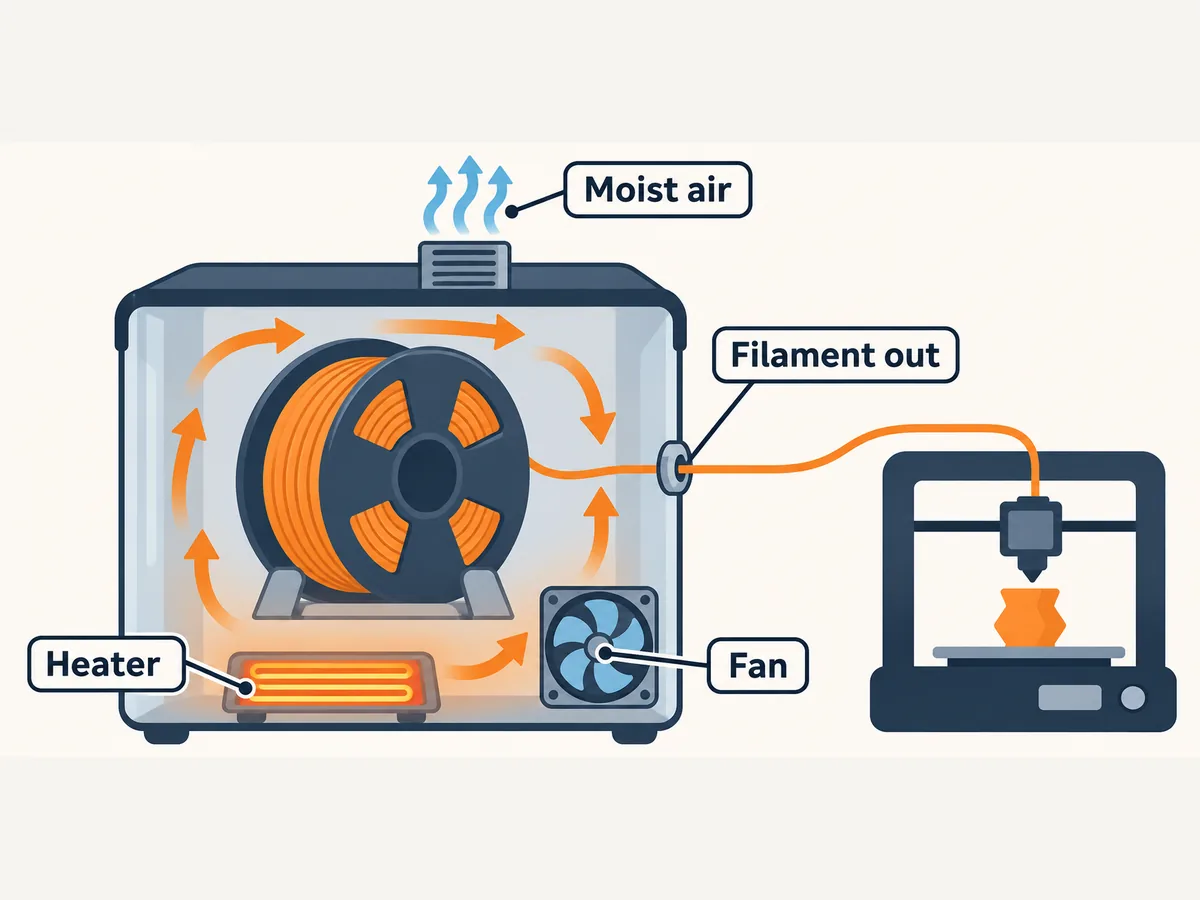
Many filaments absorb moisture from the air. Wet filament can pop and hiss at the nozzle, string, and give rough, weak prints. A filament dryer is a small heated box that holds a spool at a set temperature for a set time, and many let you print straight from the box. This guide compares five dryers listed on Amazon UK on 15 November 2026, using each listing's stated features.
For the whys and hows of moisture, read storing and drying filament first.
Quick comparison
| Dryer | Stated temperature | Stated timer | Notable features | Price, checked 15 Nov 2026; sale prices change |
|---|---|---|---|---|
| Sunlu S1+ | Not on the listing we read | Not on the listing we read | Built-in fan, compact | Around £29.99 |
| eSUN eBOX Lite | Up to preset | Preset time | PI heating, clear lid, doubles as storage | Around £29.99 |
| Sunlu S2 | 35–70 °C | 1–99 hours | 360° heating, touch screen | Around £44.99 |
| Creality Space Pi | 45–70 °C | 0–48 hours | 110 W PTC heater, fan, 12 one-key presets, 1.75 and 2.85 mm | Around £68 on Amazon; around £53 on Creality UK |
| Polymaker PolyDryer Type A | 3 power levels | Not on the listing we read | Modular: drying dock plus sealed storage boxes | Around £76.26 |
"Not on the listing we read" means the Amazon page we opened did not state it. Check the maker's manual before buying.
Budget: Sunlu S1+ and eSUN eBOX Lite
Sunlu S1+ (around £29.99, checked 15 November 2026; sale prices change). Sunlu describes it as an upgraded S1 with a built-in fan for even heating, compact and portable, for PLA, PETG, ABS and more. A sensible first dryer for PLA and PETG.
eSUN eBOX Lite (around £29.99, checked 15 November 2026; sale prices change). eSUN says it heats to your preset temperature for a preset time using PI heating with a curved metal sheet, has a transparent lid so you can see how much filament is left, and can be used as a dust- and moisture-proof storage box while printing.
Mid-range: Sunlu S2
Sunlu S2 (around £44.99, checked 15 November 2026; sale prices change). Sunlu lists a 35–70 °C range, a 1–99 hour timer, 360° surround heating with double heat sinks, a touch screen, and says the temperature difference between points inside is less than 1 °C. The wider timer is handy for long drying runs.
Fan-assisted with presets: Creality Space Pi
Creality Space Pi (around £68 on Amazon UK; around £53 on the Creality UK store, checked 15 November 2026; sale prices change, so compare). Creality lists a 110 W PTC heater with 360° hot-air circulation, one-key settings for 12 filament types (PLA, ABS, TPU, PETG, PP, PC, PA, PET, PLA-CF, PA-CF, PETG-CF and ASA), a 45–70 °C adjustable range and a 0–48 hour timer. It fits 1 kg spools of 1.75 or 2.85 mm filament. Creality UK also listed newer Space Pi models, including the SpacePi X4 rated up to 85 °C.
Modular storage and drying: Polymaker PolyDryer
Polymaker PolyDryer Type A (around £76.26, checked 15 November 2026; sale prices change). Polymaker describes a 2-in-1 drying and storage system: one drying dock works with as many PolyDryer boxes as you buy, the boxes are sealed for storage, and the dock gives 360° airflow with three preset power levels. Good if you want dry storage for several spools as well as drying.
The temperature limit that matters
Most consumer dryers in this list top out at 70 °C. That covers the drying temperatures many makers give for PLA, PETG and TPU, but not every material. Prusa, for example, recommends drying Prusament PA11 nylon at 90 °C for 6–8 hours if you are unsure how long the bag has been open, which is beyond a 70 °C dryer. Always use your filament maker's drying temperature and never exceed the temperature your spool can take: some plastic spools soften well below nylon drying temperatures.
Not every filament needs regular drying. Prusa says its TPU 95A has very low moisture absorption and that drying is usually not necessary.
For a table of makers' drying temperatures and times by material, our sister site Filament Drying Lab has a filament drying table that links each figure to the maker.
Dryers built into printers and feeders
Some newer printers and multi-colour units dry filament themselves. Bambu Lab lists filament drying among the P2S features, and Anycubic lists "active drying supported" on the unit with the Kobra 4 Combo. Check the maximum temperature and whether you can dry while printing before relying on one.
Which should you buy?
- Printing mainly PLA and PETG on a budget: a basic fan-assisted dryer such as the Sunlu S1+.
- Want presets and a fan: Creality Space Pi, and check the Creality UK store price.
- Want precise control and long timers: Sunlu S2.
- Several spools to keep dry: Polymaker PolyDryer with extra boxes, or a dryer plus sealed boxes (see storing and drying filament).
- Nylon or engineering materials: check the maker's drying temperature first; you may need a dryer rated above 70 °C.
Can I dry filament in a kitchen oven?
We would not: a kitchen oven is built for cooking, not for holding plastic at a steady low temperature for hours, and if it runs hotter than its dial says it can soften the filament or the spool. A dedicated dryer is the safer choice. Whatever you use, follow the filament maker's guidance and do not leave it unattended.
Do I need a dryer if I store filament sealed?
Good storage reduces how often you need to dry, but spools that have been left out, or materials that absorb water quickly, may still need drying before use.
Sources
Opened and checked on 15 November 2026.
- Amazon UK listing: SUNLU Filament Dryer S1+ with Fan
- Amazon UK listing: SUNLU Filament Dryer Box S2
- Amazon UK listing: Creality Space PI Filament Dryer
- Amazon UK listing: eSUN eBOX Lite Dryer Box
- Amazon UK listing: Polymaker PolyDryer Type A
- store.creality.com/uk/products/creality-space-pi-filament-dryer
- prusament.com/materials/prusament-pa11/
- prusament.com/materials/prusament-tpu-95a/
- uk.store.bambulab.com/products/p2s
- uk.anycubic3d.com/products/kobra-4-combo-3d-printer
- filamentdryinglab.co.uk/tools/filament-drying-table/